Structural Analysis and FEM Simulations
At a glance
- 01Static sizing of primary and secondary structures
- 02Global and detailed FE models in HyperMesh
- 03Fatigue calculation and Transfer Function definition
- 04Thermoelastic analysis for satellites and space structures
FEM simulations, based on the finite element method, let us predict how a structure will behave before it is built. As a result, components get lighter, prototypes are fewer and tests bring fewer surprises.
Structural analysis: from load to margin of safety
Everything starts from the load cases: manoeuvres, landings, gusts, emergency loads and thermal conditions. For each one we first derive the internal loads in the components, then compare them with the material allowables and finally calculate the margin of safety. As a result, a positive margin says the part holds, while one that is too high says we can make it lighter.
FEM simulations with global and detailed models
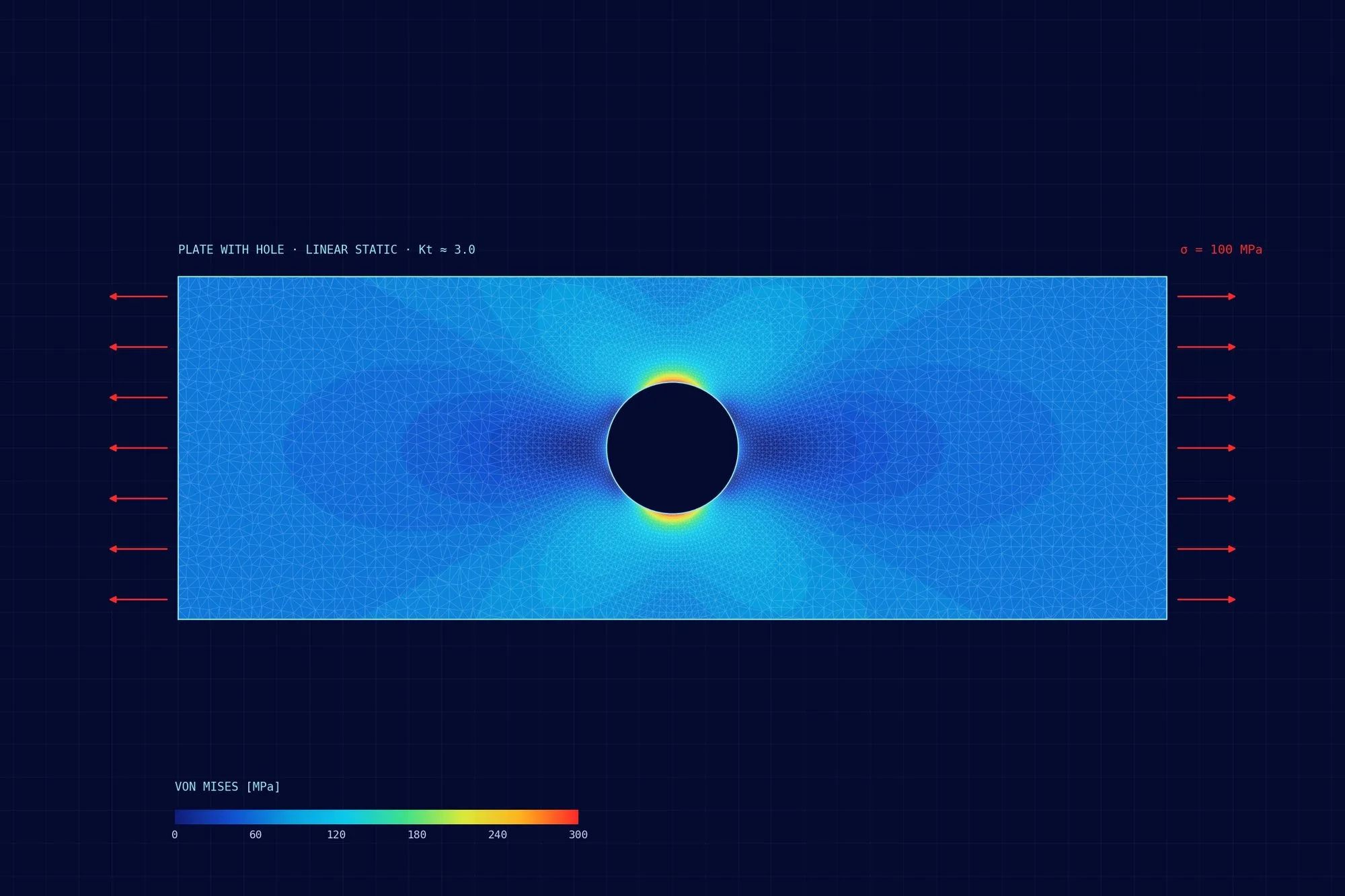
A global FE model represents the whole structure with relatively large elements. In fact, it shows how loads spread and which forces reach each component. The detailed model, instead, applies those forces to a smaller area with a fine mesh, to read stresses accurately around holes, fillets and attachments.
We build both in HyperMesh, with element quality checks and load balance verifications. Then we solve them with OptiStruct and MSC Nastran.
Fatigue analysis and Transfer Function definition
Aircraft structures are subject to loads that vary over time and can trigger fatigue even without exceptional overloads. To assess their strength and estimate their service life, it is essential to understand how stresses at structurally critical points change as load conditions change.
The Transfer Function describes the relationship between the loads applied to the structure and the local stress response at the points of interest. Defined from the finite element (FE) model, it makes it possible to rebuild the stresses associated with different load combinations and operating conditions, reducing the need to run complete structural analyses again and again.
This approach makes it possible to process load spectra efficiently and to support the subsequent fatigue life assessments over a large number of flight conditions.
SIM4FLIGHT has also applied this methodology to the AW09 programme, defining the Transfer Functions that support the fatigue analyses within the structural verifications.
Thermoelastic loads in space
In orbit a satellite moves from sunlight to the Earth’s shadow several times a day. As a result, temperature swings distort the structure and can misalign instruments and panels. With thermoelastic FEM simulations we calculate deformations and stresses from temperature maps, as in the work done for the OHB Italia Space Program.
What we deliver
- Documented, reusable FE models in the formats you require
- Linear and non-linear static, modal and vibration analyses
- Fatigue calculation and Transfer Function definition
- Thermoelastic analyses for space structures
- Reports with results, margins and acceptance criteria
What we verify
- Metallic primary and secondary structures
- Joints: riveted and bolted joints, attachments and fittings
- Stability of panels and stringers (compression and shear buckling)
- Interior and furnishing components, such as crashworthy seats
- Ground support equipment and test rigs
Frequently asked questions
What are FEM simulations?
They are numerical analyses that divide a structure into many small elements and calculate their deformation and stress under load. As a result, you can verify a component before you manufacture and test it.
What does structural sizing mean?
It means defining the thickness, materials and geometry of a component so that it withstands every design load case with the required margins, without excess weight.
What is the difference between Limit Load and Ultimate Load?
Limit Load is the maximum load expected in service: the structure must not deform permanently. Ultimate Load equals Limit Load times a safety factor, usually 1.5: the structure must not fail.
Which software do you use?
HyperMesh to build models, OptiStruct and MSC Nastran as solvers, HyperView for post-processing.
What is the difference between a global and a detailed model?
The global model shows how loads spread across the whole structure. The detailed model, instead, receives those loads and calculates stresses accurately in a critical area, such as an attachment or a hole.
What is a Transfer Function in fatigue analysis?
It is the relationship between external loads and the stress at a critical point. Once defined on the FE model, it makes it possible to calculate fatigue life over many load conditions.
Do you have experience with satellites?
Yes. In the OHB Italia Space Program we performed structural analyses to assess the satellite's behaviour under extreme thermoelastic loads.