
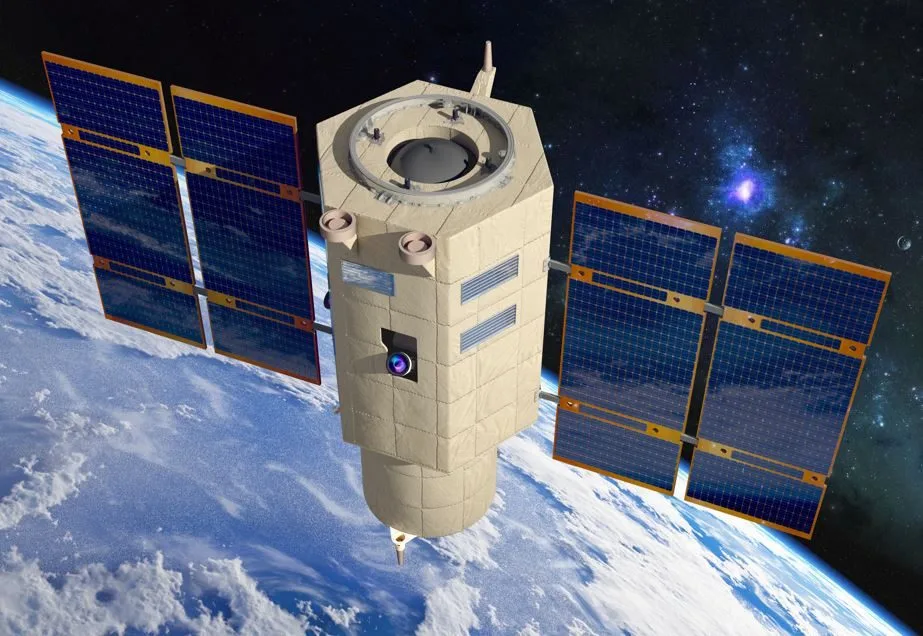
LWSPA (Light Weight Solar Panel Array) and Genesis are two highly ambitious space programmes developed by OHB Italia.
The LWSPA programme develops a new-generation deployable solar panel. It offers high power density and an extremely compact, lightweight design in the stowed configuration. Once deployed in orbit, the system can generate up to 10 kW of electrical power. This meets the needs of future space missions for efficiency, lightness and compact volume. SIM4FLIGHT developed the finite element (FE) model of the solar panel in both configurations, stowed and deployed. We also sized the components against launch loads and the load conditions expected in orbit.
The European Space Agency (ESA) promotes the Genesis mission. It involves a satellite that will operate as a space geodetic observatory. Its goal is to improve terrestrial reference systems and reach millimetre accuracy in geodetic measurements. Within this programme, SIM4FLIGHT verified the structure of numerous connecting elements. We assessed their behaviour under launch loads and under the thermo-structural stresses expected in orbit.
Thermoelastic loads on the OHB Genesis satellite
In orbit, a satellite repeatedly moves through sunlight and eclipse. These thermal cycles make materials expand and contract, so the structure deforms. In high-precision systems, even a few tenths of a millimetre can affect the alignment of instruments, antennas and panels.
The analysis becomes more complex when the structure combines different materials, such as composites, aluminium alloys and titanium. Each one has a different coefficient of thermal expansion. Interfaces between dissimilar materials, in particular joints and inserts, are therefore critical areas. They need accurate modelling to assess the stress distribution and the deformations that thermal cycles cause.
SIM4FLIGHT carried out thermo-structural analyses starting from temperature maps. We developed finite element models in HyperMesh and solved them with OptiStruct. In this way we assessed the deformations and stress state of the components under the operating conditions expected in orbit.
Why it matters for a space programme
The analyses SIM4FLIGHT carried out for the LWSPA and Genesis programmes help to predict and document thermoelastic behaviour. They support the qualification process.
This experience falls within our numerical simulation and structural analysis capabilities. They also apply to antennas, optical instruments and solar panels, where dimensional stability and alignment in orbit are essential.
Are you developing a system or component for space applications? Contact SIM4FLIGHT to discuss your analysis and structural verification needs. We can also work under non-disclosure agreements.
Main activities
- 01Finite element model development
- 02Structural Analyses Under Thermoelastic Loads